ServicesHome Battery Backup
Home Battery Backup Systems in Cleburne
We install home battery backup that switches over quietly when the grid drops and keeps your fridge, well pump, lights and internet running. We size the system to your actual loads and build every connection to stay tight for the life of the equipment.
How Battery Backup Keeps Your Lights On
Inside the cabinet, lithium cells hold a charge and an inverter converts that DC energy into the 120/240-volt AC your circuits run on. The moment the utility feed fails, an automatic disconnect separates your home from the grid and the battery picks up the load, usually quickly enough that clocks and routers stay on. Nothing burns fuel, nothing vents exhaust and no engine starts.
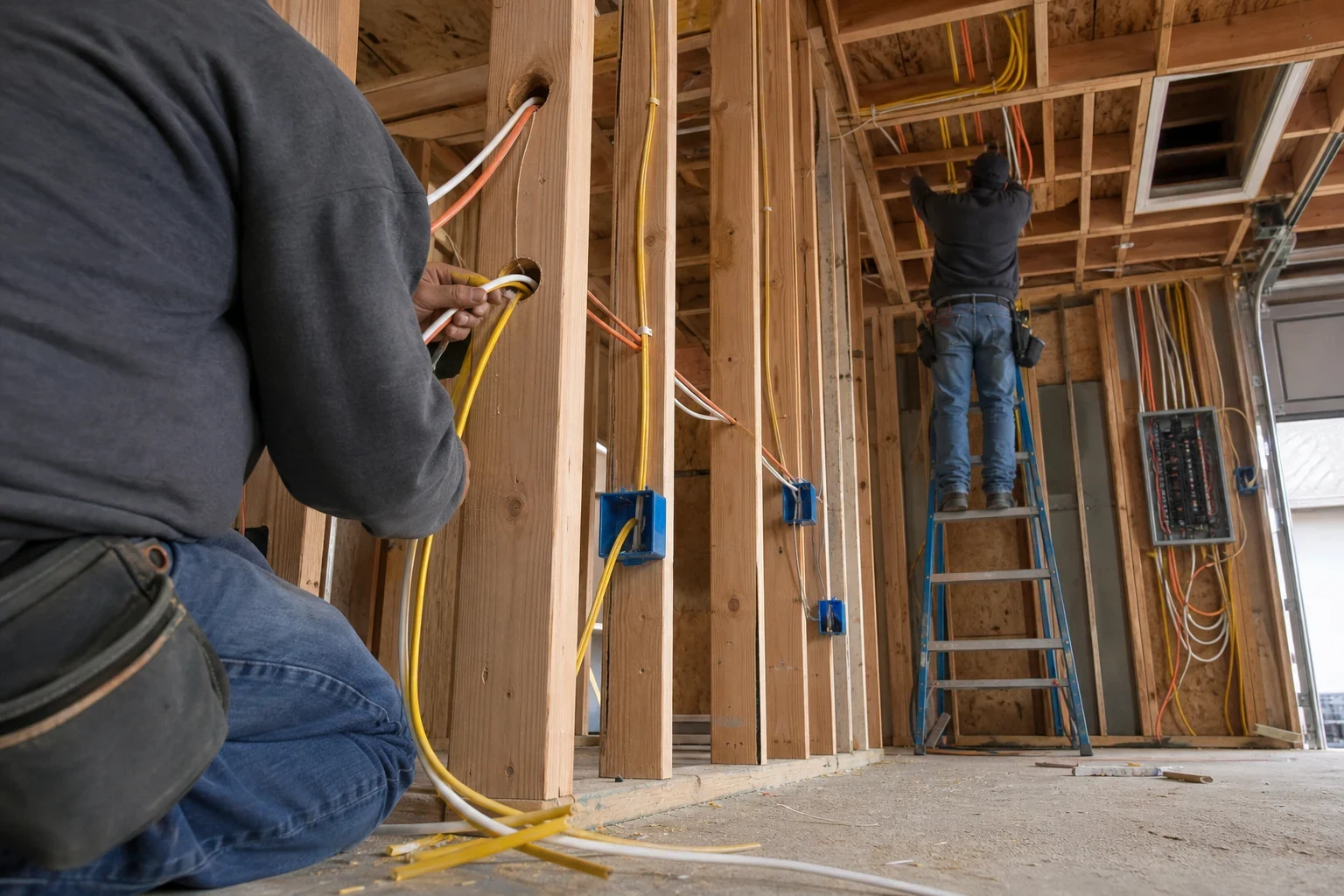
Most of the work that decides how long the system lasts is invisible once the covers go on. Conductor sizing for continuous load, torque on every lug, a solid grounding connection, conduit that keeps sun and moisture off the wiring, and a mounting spot that keeps the battery out of the worst heat. Those details are where we spend our time.
A battery is often the right call if outages are short to medium length and you want silent, automatic backup. For long outages or heavy loads like whole-house central air, our generator installation page covers the other option, and we will tell you plainly which one fits.
What the Installation Includes
Load study and sizing
We list the circuits you want backed up and measure or calculate their draw, including startup surge on motors like well pumps and AC compressors. That tells us the inverter output and battery capacity you need, so you are not paying for storage you will never use.
Critical-load panel or whole-home transfer
Most systems feed a dedicated backup subpanel holding only the essential circuits. We move those breakers over, label every one, and leave a printed panel schedule so you know what stays on during an outage.
Mounting and clearances
We mount the battery and inverter on a solid backing with the clearances the equipment requires. In a garage we add impact protection where a vehicle could reach the unit.
Wiring, conduit and terminations
Conductors are sized for continuous duty, run in conduit rated for the location, and terminated with the correct lugs torqued to the manufacturer's value. A loose lug on a battery circuit runs hot under load and slowly cooks the insulation, so we check each one twice.
Permit, inspection and utility coordination
We pull the permit and schedule inspection as required by your local jurisdiction, and handle any utility paperwork the setup requires.
Signs Battery Backup Makes Sense for Your Home
Short outages keep costing you
If a few hours without power means spoiled food, a reset network or a stopped well pump, a battery covers exactly that kind of outage without any action from you.
Someone at home relies on powered equipment
Oxygen concentrators, CPAP machines and refrigerated medication need power that does not wait for someone to start a generator.
You want backup without fuel or noise
A battery has no gasoline to store, no oil to change and nothing to run outdoors. It also works where a portable generator would bother neighbors.
Your workday depends on a connection
A modem, router and laptop with a couple of lamps draw very little power together. Even a smaller battery carries that through an afternoon outage, so a video call or upload does not drop.
Summer storms or winter freezes leave you in the dark
Texas weather can knock out power in any season, and a charged battery is ready when the lines go down.
How a Battery Backup Job Runs
- 1
Site visit and load list
We look at your main panel, the service size, the spot you have in mind for the equipment and the circuits you care about. We also check whether the panel has room for the backup connection or needs work first, which our panel upgrades page explains.
- 2
Written plan
You get the battery and inverter size, where each component goes, which circuits move to backup, and the full scope written out line by line before anything is ordered.
- 3
Install day
Equipment goes on the wall and conduit gets run while your home still has power. Only when we rebuild the backup panel and land the final terminations do we cut the main, and we schedule that outage with you ahead of time and keep it as brief as the work allows.
- 4
Testing and walkthrough
We simulate an outage by opening the main, confirm the transfer, measure voltage under load and verify the battery recharges. Then we show you the display, the app if there is one, and what each indicator means.
- 5
Inspection
We meet the inspector as required and correct anything flagged before we call the job done.
What Moves the Cost of Battery Backup
Battery backup pricing depends mostly on how much you want to keep running and for how long. The equipment is the largest share, but the condition of your existing panel and the distance between components matter too. We explain each piece on the written estimate so nothing appears later.
- Storage capacity and inverter output
- More kilowatt-hours of storage cost more. Running motor loads like a well pump or AC calls for a larger inverter to handle startup surge.
- Partial versus whole-home backup
- A critical-load panel with a handful of circuits is simpler than backing up the entire service, which needs a larger transfer device and more capacity.
- Panel condition and space
- An older or full main panel may need replacement or rework before a battery can connect safely.
- Location and wire runs
- A long run from the panel to the battery means more conductor and conduit, and outdoor or exposed locations may need different mounting and protection.
Battery Backup Questions
Something not covered here? (682) 399-7732
How long will a battery run my house?
Run time comes down to the stored kilowatt-hours versus what is drawing power. A refrigerator, lighting, the router and a few receptacles use little and stretch a charge a long way. Central air pulls hard and shortens it sharply. On the site visit we estimate run times from the loads in your home, not from a brochure.
Can a home battery run my air conditioner?
Some systems can, but AC compressors pull a large surge at startup and use a lot of energy per hour. That takes a bigger inverter and more storage. If cooling through a long outage is the main goal, a generator may fit better, and we will tell you so.
Where does the battery go?
Usually on a garage wall or an exterior wall near the main panel. We pick a spot that meets the required clearances and stays out of direct afternoon sun, since lithium batteries lose capacity and age faster when they run hot.
Do you handle the permit?
Yes. We pull the permit, schedule inspection as your local jurisdiction requires, and take care of utility paperwork where the setup needs it.
Should I add surge protection at the same time?
It is a sensible pairing. Inverters and their control boards are sensitive electronics, and a whole-home surge protector at the panel helps shield them. Our surge protection page has more detail.
Find Out What Your Home Needs to Stay Powered
We will look at your panel, list your loads and give you a written plan for a battery system sized to them. Serving Cleburne and nearby towns including Burleson, Joshua and Keene.