ServicesElectrical Repair
Electrical Repair in Cleburne, Down to the Last Connection
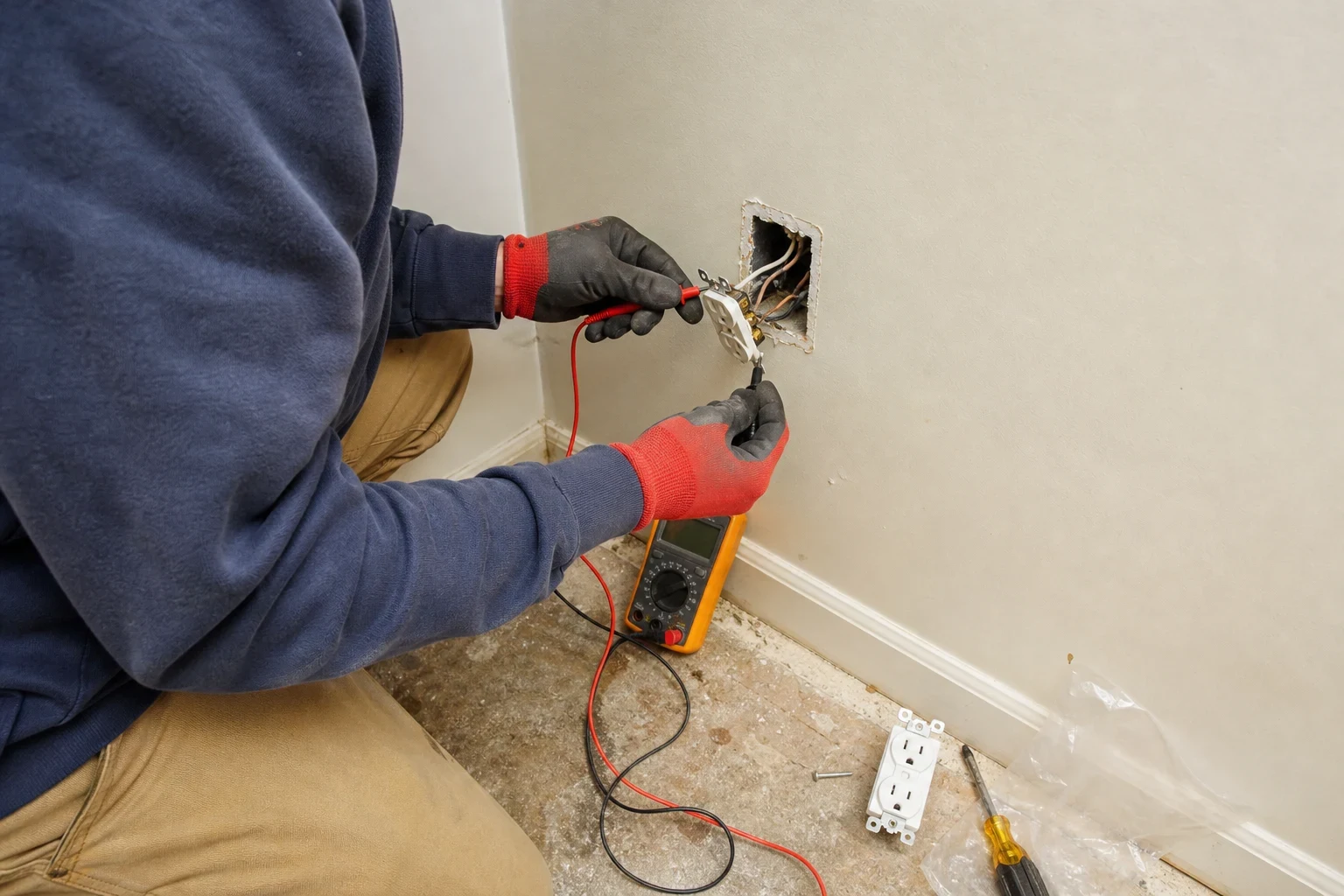
When an outlet goes dead or a breaker keeps tripping, the cause is usually one connection that stopped making good contact. We test the circuit, open the boxes, find that point and rebuild it properly so the same problem does not come back next season.
Most Faults Start at One Bad Connection
A receptacle wired through its push-in backstab holes, a wire nut that was never twisted tight, a breaker lug that loosened after years of heating and cooling. Any of these can cause trouble, and the symptom often shows up somewhere else: a dead outlet two rooms away, lights that dim when the microwave runs, a breaker that trips every afternoon.
Our electrical repair work starts by finding that point, not by swapping the part you can see. We test with a meter under load, open the boxes on the affected circuit and trace the fault to its source. Then we remake the connection the way it should have been made the first time: insulation stripped to the right length, conductors looped clockwise under the screw terminal and tightened to the device maker's torque rating.
If what we find points to a larger issue, such as a failing panel or brittle insulation throughout your home, we say so plainly and walk you through options like panel upgrades or whole-home rewiring. If a repair will hold, that is what we do.
What Our Electrical Repair Covers
Dead outlets and switches
We replace worn devices with spec-grade receptacles and switches. Wires come out of backstab holes and go under screw terminals or back-wire clamps, which hold far better as the copper expands and contracts.
Breakers that trip
We work out what sits behind the trip: more load than the circuit was sized for, two conductors touching inside a box or cable, current leaking to ground, or a breaker whose trip mechanism has weakened with age. Nuisance trips on arc-fault and GFCI breakers often come from a shared neutral or a nicked cable, and we track down which one.
Flickering and dimming lights
Flicker across several rooms often means a loose neutral. We check the neutral bar in your panel and the service connections, and if the problem is on the utility side, we tell you exactly what to report.
Scorched or hot devices
Heat at a cover plate means resistance at a connection. We cut the conductor back to clean, bright copper and replace any melted box or device rather than reconnecting to damaged wire.
Outdoor receptacles and GFCI protection
Exterior outlets take sun, rain and sprinkler spray. We replace failed GFCI devices, reseal boxes and fit in-use covers that keep water out while something is plugged in.
Signs Your Home Needs an Electrical Repair
The same breaker keeps tripping
One trip can be a fluke. Repeated trips on one circuit mean too much load, a fault in the wiring or a breaker that no longer holds its rating.
Lights dim when appliances start
A brief dip when the AC compressor kicks on can be normal. A deep dim or flicker that spreads to other rooms points to a loose connection or neutral.
Warm plates or a burning smell
A switch or outlet cover that feels warm, looks discolored or smells like hot plastic has a connection arcing behind it. Turn that circuit off and book a visit.
Buzzing or crackling
Sound from a box, fixture or panel means current is jumping a gap. That gap gets worse with every cycle.
Plugs that fall out or work on and off
Worn receptacle contacts lose their grip on the plug blades, which creates heat at the contact point. Replacing the device fixes it.
How a Repair Visit Runs
- 1
Tell us what you're seeing
On the phone, we ask which outlets or lights are affected, when it happens and what was running at the time. Those details shorten the trace.
- 2
Test and trace
We map the circuit, measure voltage under load and open the boxes along it. Loose terminals and heat damage usually show themselves once the device is pulled.
- 3
Explain before we fix
We show you what failed, explain why it failed and give you the cost of the repair before any work begins. You decide how to proceed.
- 4
Repair, retest and clean up
We remake the connections, replace what is damaged and retest the circuit under load. Breakers we touch get labeled, and we clean up the work area before we leave.
What Moves the Cost of a Repair
Most of the price on a repair is time spent finding the fault, not the parts. A loose wire at the first outlet is a quick job; an intermittent fault buried in a finished wall takes longer. We give you the repair cost once we know the cause, before we start the work.
- How hard the fault is to find
- A problem that shows up every time is faster to trace than one that comes and goes with temperature or load.
- Access to the wiring
- Boxes in open walls are straightforward. Runs through a finished ceiling, a crawlspace or a hot summer attic take more time to reach safely.
- Parts the circuit needs
- A standard receptacle costs little. Arc-fault or dual-function breakers, weather-rated GFCI devices or a new box add to the total.
- Condition of nearby wiring
- If the conductor is heat-damaged for several feet, we replace that section instead of splicing onto weak copper.
- Permits where required
- Some repairs call for a permit and inspection under the local jurisdiction. When one is needed, we pull it and include it in the cost.
Electrical Repair Questions
Something not covered here? (682) 399-7732
What makes one breaker trip over and over?
The usual culprits are a circuit asked to carry more amperage than its wire and breaker are rated for, a wiring fault such as a hot conductor touching ground or neutral, or an aging breaker that now opens below its rating. A meter reading under load and a look inside the boxes tell us which one you have. Flipping it back on again and again without a cause just lets the fault keep heating up.
Can you fix just one outlet, or does the whole circuit need work?
Often one device is the problem and replacing it solves everything. When an outlet is dead, though, the failed connection is frequently upstream at another box on the same circuit. We check the full run so the fix actually holds.
Is flickering in several rooms serious?
It can be. Flicker across multiple rooms often comes from a loose neutral at the panel or service, which can push uneven voltage to your appliances. It is worth having checked soon.
Do repairs need a permit?
Replacing a like-for-like device usually does not. Work that adds or extends a circuit, or changes the panel, may require a permit and inspection depending on the local jurisdiction. We tell you up front and handle it when it applies.
Should I replace backstabbed outlets even if they still work?
Push-in connections grip the wire with a small spring contact that loosens over time. If we are already working on a circuit, moving those wires to the screw terminals is quick and removes a common failure point.
Get the Fault Found and Fixed Properly
Tell us what is happening in your home and we will set a time to trace it. You see what failed and what it costs before we fix anything.