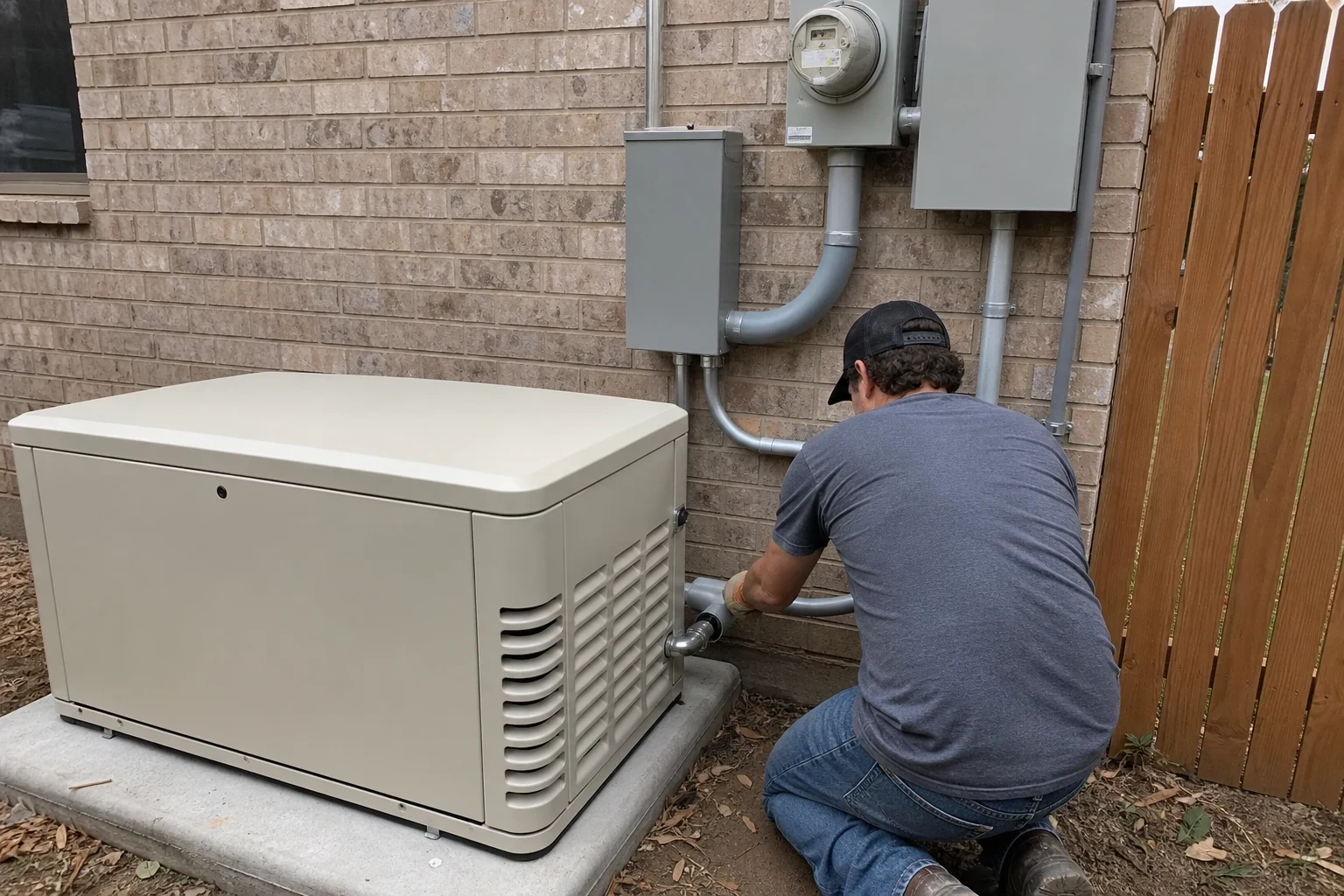
Is It Worth Installing a Car Charger at Home in Cleburne?
The charger is the easy part to pick. The circuit, the panel and the terminations behind it decide whether it works well for years.
Is it worth installing a car charger at home?
Yes, for most EV and plug-in hybrid owners a Level 2 charger at home is worth it. It refills a typical daily commute in a few hours overnight, avoids public stations and is far faster than a 120V cord. The value depends on a properly sized circuit and enough panel capacity. To check yours, book a visit at (682) 399-7732.
What a Level 2 charger changes compared with the cord in the trunk
Most EVs ship with a Level 1 cord that plugs into an ordinary 120V outlet. It adds only a few miles of range per hour, so a long drive or a cold morning can leave you short by the next day. A Level 2 charger runs on 240V, the same kind of circuit a dryer or range uses, and adds range several times faster.
For many owners the real benefit is routine. You plug in when you get home, the car is full by morning, and you rarely think about charging again. If your electric plan has cheaper overnight hours, most cars and chargers let you schedule charging to start then.
A home charger is less worth it if you drive very little, have reliable charging at work, or rent and may move soon. Even then, many people find the convenience changes how they use the car.
- Level 1 (120V): slow, fine for short commutes or a plug-in hybrid with a small battery
- Level 2 (240V): overnight refill for most daily driving, the common home choice
- Hardwired or plug-in: both are Level 2; the difference is how the unit connects to the circuit
Can your panel handle an EV charger?
A Level 2 charger is a continuous load, meaning it can draw full current for hours. The electrical code treats continuous loads at 125 percent, so a charger set to 32 amps needs a 40-amp breaker and conductors rated for it. A 48-amp hardwired unit needs a 60-amp circuit. That is a large share of a 100-amp service, and still noticeable on a 200-amp one.
Before we recommend a charger size, we do a load calculation on your home: the air conditioning, electric water heater, range, dryer and anything else that runs at the same time. A long Texas summer means the AC is often running when the car is charging, so that overlap matters. If the numbers are tight, there are options short of a full upgrade, such as setting the charger to a lower amperage or using a load-management device. When the panel is truly out of room or in poor condition, a panel upgrade is the honest answer.
The installation details that decide how long it lasts
Most charger failures we see are not the charger itself. They are a cheap receptacle that heated up, an aluminum-to-copper connection without the right lug, or a terminal screw that was never torqued to spec and loosened over many heat cycles. A charger pulling 32 or 40 amps for hours will find any weak connection.
If you choose a plug-in unit, we use an industrial-grade NEMA 14-50 or 6-50 receptacle, not the light-duty version sold for occasional dryer use. Current code calls for GFCI protection on that garage receptacle, and some chargers have their own ground-fault sensing that can cause nuisance trips with it. That is one reason we often suggest hardwiring: fewer connection points and no receptacle to wear out.
We run the conductors in conduit where they could be damaged, size the wire for the breaker and the run length, and torque every lug and terminal with a calibrated driver to the manufacturer's value. In a garage that bakes through the afternoon, wire insulation rating and conduit routing are worth getting right the first time.
- Copper conductors sized for the breaker and the distance from the panel
- Torque-to-spec terminations at the breaker, any junction and the charger
- Mounting height and cord reach planned around where you actually park
- Weatherproof unit and in-use cover if the charger goes outside
Permits, inspection and what install day looks like
A new 240V circuit for a charger is permitted work. We pull the permit and schedule inspection as required by the local jurisdiction, in Cleburne and in nearby towns such as Joshua, Burleson and Keene. The inspection is a second set of eyes on breaker size, wire size, grounding and GFCI protection.
On a straightforward job with the panel in or next to the garage, the work usually fits in one visit. Longer runs through an attic or across the house, a detached garage, or panel work add time. We protect the floor and walls near the panel, test the circuit under load with your car connected, and walk you through the charger's app or settings before we leave.
More questions about home car chargers
Something not covered here? (682) 399-7732
Do I need a special charger for my car brand?
Most cars sold in the US now use either the J1772 or the NACS connector, and adapters are common. We help you pick a unit that matches your car's onboard charger so you are not paying for amperage the car cannot use.
Can the charger go outside in the driveway?
Yes, as long as the unit is rated for outdoor use and the circuit is protected for wet locations. We plan the conduit route and mounting so the cord reaches without crossing a walkway.
Should I add surge protection with a charger?
A charger has sensitive electronics, and so does the car's charging system. A whole-home surge protective device at the panel is a sensible add-on, and we can install it during the same visit.
Find out what your home needs for a Level 2 charger
Book a service visit and we will check your panel, run the load calculation and lay out the charger location, circuit size and wire route in a written estimate.